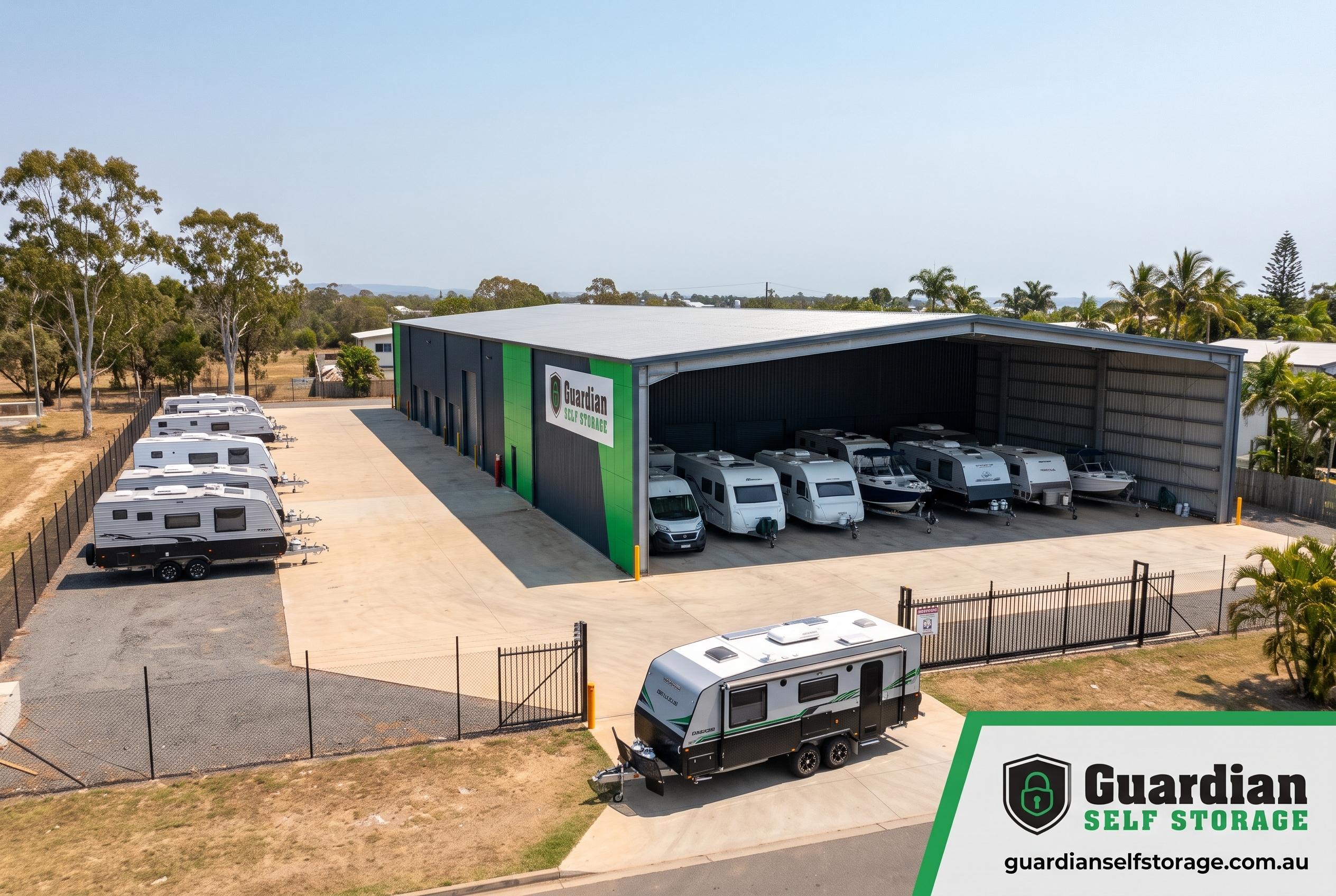
When choosing indoor vs outdoor caravan storage, your location dictates the true cost of ownership. Parking an expensive rig within reach of the Pacific Ocean is a whole different beast than parking it out west in Dubbo or Roma.
A friend of mine parked his near-new tandem off-roader on a coastal grass pad near Coffs Harbour for two wet summers. By month fourteen, the silicone seams had yellowed and split, moisture had seeped into the side panels, and the AGM battery bank was completely cooked. He saved sixty dollars a month on open-air parking fees, but he ended up with a six-thousand-dollar repair invoice.
Between the blazing heat of North Queensland and the violent summer supercells sweeping through northern New South Wales, the coastal elements work around the clock to wreck your setup. Making a sensible choice between an open hardstand, a roofed canopy, and a fully lockable unit means weighing your asset depreciation rate against storage fees. This guide breaks down the physical, electrical, and structural realities of parking your caravan along the eastern seaboard.
Coastal Weather Realities: What Your Rig Faces
The coastline from the Sunshine Coast down past Wollongong presents a severe microclimate. According to the Australian Radiation Protection and Nuclear Safety Agency (ARPANSA), coastal Queensland and northern NSW frequently hit extreme UV indices of 11 to 14 throughout summer.
Constant, high UV exposure leads to rapid seal dry rot around corner moulds, roof hatches, and windows. At the same time, coastal salt air spray drifts inland for kilometres. Salt residue settles on chassis rails, leaf springs, and brake assemblies, accelerating corrosion.
Add severe subtropical storm fronts into the mix. The Insurance Council of Australia routinely logs millions of dollars in caravan storm claims following regional hail and localized flash flooding.
A thorough regional weather impact assessment reveals four major culprits:
- UV seal degradation: Sunlight breaks down polymer-based caulking, leaving seams brittle.
- Thermal expansion: Huge temperature swings cause composite walls and aluminium frames to expand and contract, pulling joints loose.
- Corrosion: Airborne salt binds to exterior metals, pitting awnings and corroding chassis steel.
- Impact damage: Hail stones can easily puncture fiberglass roofs and shatter rooftop fixtures.
Outdoor vs Undercover vs Enclosed: Feature Comparison
Every facility uses a slightly different tier-based pricing structure. Here is how the three main options perform against regional coastal risks.
| Feature / Threat | Open Hardstand (Outdoor) | Shade Cloth / Hail Netting | High-Clearance Bays (Roof Only) | Fully Enclosed Unit (Indoor) |
| Direct UV Exposure | 100% | Reduced by 70% to 90% | Zero direct overhead sun | Zero |
| Hail & Debris Protection | None | Good against small stones | Excellent structural protection | Complete structural barrier |
| Salt Air Exposure | Maximum | High | High | Low to minimal |
| Moisture & Condensation | High (rain & dew) | High (damp cycles) | Moderate | Controlled |
| Solar Charging | Full output | Limited output | Negligible / zero | None |
| Monthly Cost | Budget-friendly | Mid-tier | Upper mid-tier | Premium |
Analyzing Indoor vs Outdoor Caravan Storage Options
1. Open Hardstand (Outdoor Storage)
An open hardstand is typically a gravel, bitumen, or concrete parking bay with no overhead shelter.
It carries the lowest upfront monthly fee. It also allows your roof-mounted solar panels to gather sun year-round. However, your van takes the full brunt of coastal storms, relentless UV rays, and corrosive sea mist. Over two to three years, the asset depreciation rate on an unshielded caravan can easily double due to faded gel coats, brittle rubber seals, and surface rust on undercarriage components.
2. Undercover Storage: Hail Netting and High-Clearance Bays
Undercover sites usually fall into two categories: tensioned shade-cloth or hail netting structures, and high-clearance bays with steel roofs and open sides.
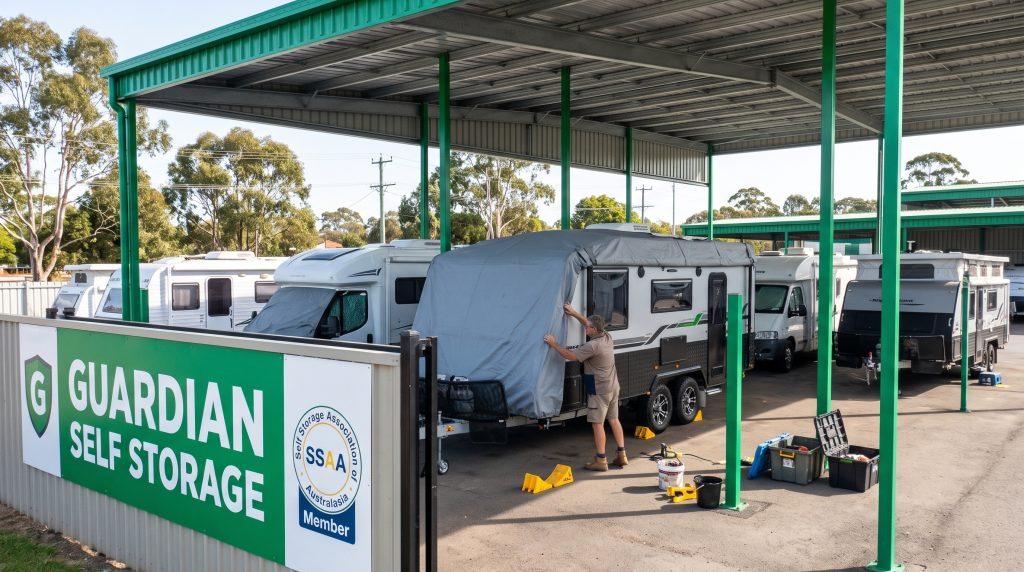
A well-engineered steel roof offers reliable structural storm protection against hail and falling tree limbs. It keeps the surface temperature of your roof substantially lower, reducing thermal stress on composite panels. However, because the sides remain open, sea breezes continue to blow salt air and drive rain across the bodywork.
3. Fully Enclosed (Indoor Storage)
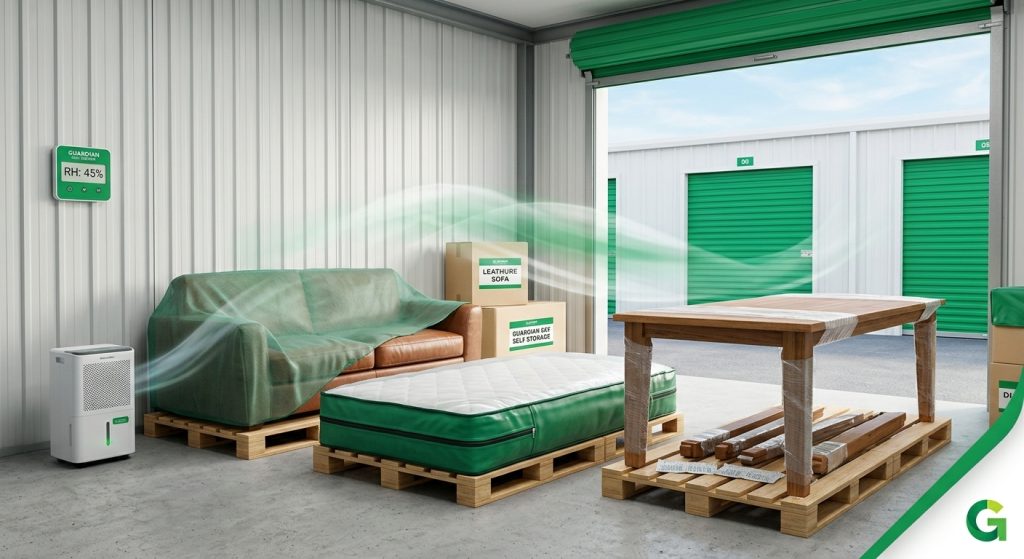
A lockable indoor bay or warehouse unit provides complete isolation from the elements.
UV degradation stops entirely, salt-laden sea breezes cannot reach the panels, and hail cannot touch your roof. Fully enclosed sheds also provide the highest facility safety evaluation ratings, as verified by Self Storage Association of Australasia (SSAA) standards. The trade-off is simple: enclosed spaces cost more, and they cut off sunlight to your roof-mounted solar system.
Battery Management and Solar Systems in Storage
One of the biggest headaches when storing a modern caravan is keeping your 12V electrical setup healthy.
Caravan Solar Panel Maintenance in Storage
If you store outdoors, your panels get sun, but they also collect dust, sap, and a sticky crust of salt air. This film creates a hard barrier that drops charging efficiency by up to 25%. If you park outside, wash your glass panels with fresh water every couple of months.
If you choose undercover or enclosed storage, do not expect your panels to do any heavy lifting. High-clearance bays block direct solar angles, and enclosed units eliminate light completely.
Keeping Caravan Battery Charged in Storage
Parasitic drains from stereo memories, safety alarms, break-away switches, and electronic brake controllers will flatten an auxiliary system within weeks. A flat battery quickly degrades internally:
- Lead-Acid and AGM: Leaving an AGM battery discharged drops cell voltage below 10.5V, causing irreversible plate sulfation. Storing an uncharged AGM in coastal summer heat cuts its lifespan in half.
- Lithium (LiFePO4): Lithium cells handle storage much better and have a minimal self-discharge rate. However, a constant minor draw that pulls a lithium battery down to 0% can trigger its Battery Management System (BMS) into safety shutdown, requiring an active jump starter to revive.
Lithium vs AGM Caravan Storage Protocols
For AGM setups, your best option is an open or semi-covered bay where solar keeps the cells floating, or an indoor spot that offers a 240V trickle-charge outlet.
For lithium batteries, charging to 100% and leaving them on a float charger under blistering heat is not ideal. Disconnect the main battery isolator switch when the pack sits around 50% to 70% state of charge. In a cool, enclosed space, an isolated lithium bank can sit happily for three to six months without any charge top-up.
Evaluating Facility Safety and Road Access
Finding the right parking spot goes beyond overhead cover. You also need to look at access, safety protocols, and physical road layout.
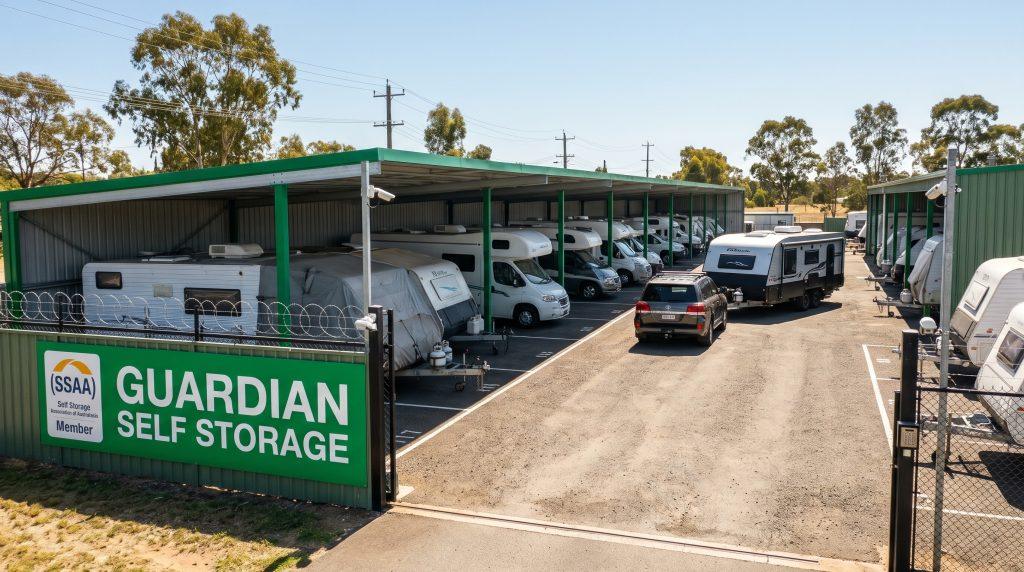
Check whether the perimeter fence is secured, whether gate access uses individual PINs, and whether CCTV covers individual bays. A reputable facility will proudly display compliance with SSAA guidelines.
Driveway clearance matters just as much. Coastal holiday zones often feature narrow access roads and steep drainage swales. Transport for NSW and local Queensland councils enforce clear roadside boundaries and turning guidelines. Ensure your facility has wide entry aprons and high turning clearances so you can swing an 8-metre caravan in without dragging your rear stabilizers on concrete curbs.
Calculating the Total Cost of Ownership (TCO)
Deciding on indoor vs outdoor caravan storage comes down to financial return. Saving $100 per month on an open hardstand looks attractive on a weekly household budget, but it rarely holds up over five years.
Consider a late-model caravan worth $85,000:
- Outdoor Hardstand ($140/month): Total five-year storage cost is $8,400. However, expect higher paint oxidation, seal resealing every two years ($1,200), accelerated battery replacement ($900), and a 15% steeper resale depreciation hit ($12,750). Total cost: $23,250.
- Covered or Enclosed Storage ($300/month): Total five-year storage cost is $18,000. Maintenance drops to routine wheel-bearing services, your original batteries survive, and your resale value stays strong. Total cost: $19,500.
The ROI on covered storage becomes obvious the day you sell or trade your rig. A clean, salt-free van with pliable rubber seals and glossy fibreglass always fetches top dollar.
Conclusion: Picking the Right Space for Your Rig
Protecting an expensive recreational vehicle along the east coast requires balancing convenience, weather protection, and your maintenance routine. If your rig is older and built on a galvanized steel chassis with basic electrics, an open hardstand combined with a breathable fabric cover might do the trick. But if you have invested in a modern off-roader with complex electronics, composite walls, and an expensive lithium bank, shade-cloth shelters, high-clearance bays, or fully enclosed sheds offer true risk mitigation value.
Take the time to inspect prospective yards in person. Review their gate systems, check turning clearances, and match their security against SSAA standards. For flexible, high-security parking bays tailored to regional conditions, reserve your secure spot with Guardian Self Storage and keep your setup road-ready for your next coastal getaway.
Ready to keep your caravan protected from coastal sun and storm damage? Check space availability today before holiday spots fill up!