This guide provides actionable inventory hacks and smart small business storage solutions to help growing businesses optimize space, streamline operations, and cut clutter efficiently.
Running a small business is a constant balancing act. One month you are celebrating a flood of new orders, and the next you are tripping over cardboard boxes, searching endlessly for misplaced items, and realizing your office space has turned into a makeshift warehouse.
When your workspace becomes chaotic, fulfillment slows down, mistakes multiply, and daily stress skyrockets. Managing stock, paper records, and digital assets requires a clear blueprint. By applying clever organizational hacks and tapping into scalable small business storage solutions, you can reclaim your space, speed up order fulfillment, and set your company up for smooth growth.
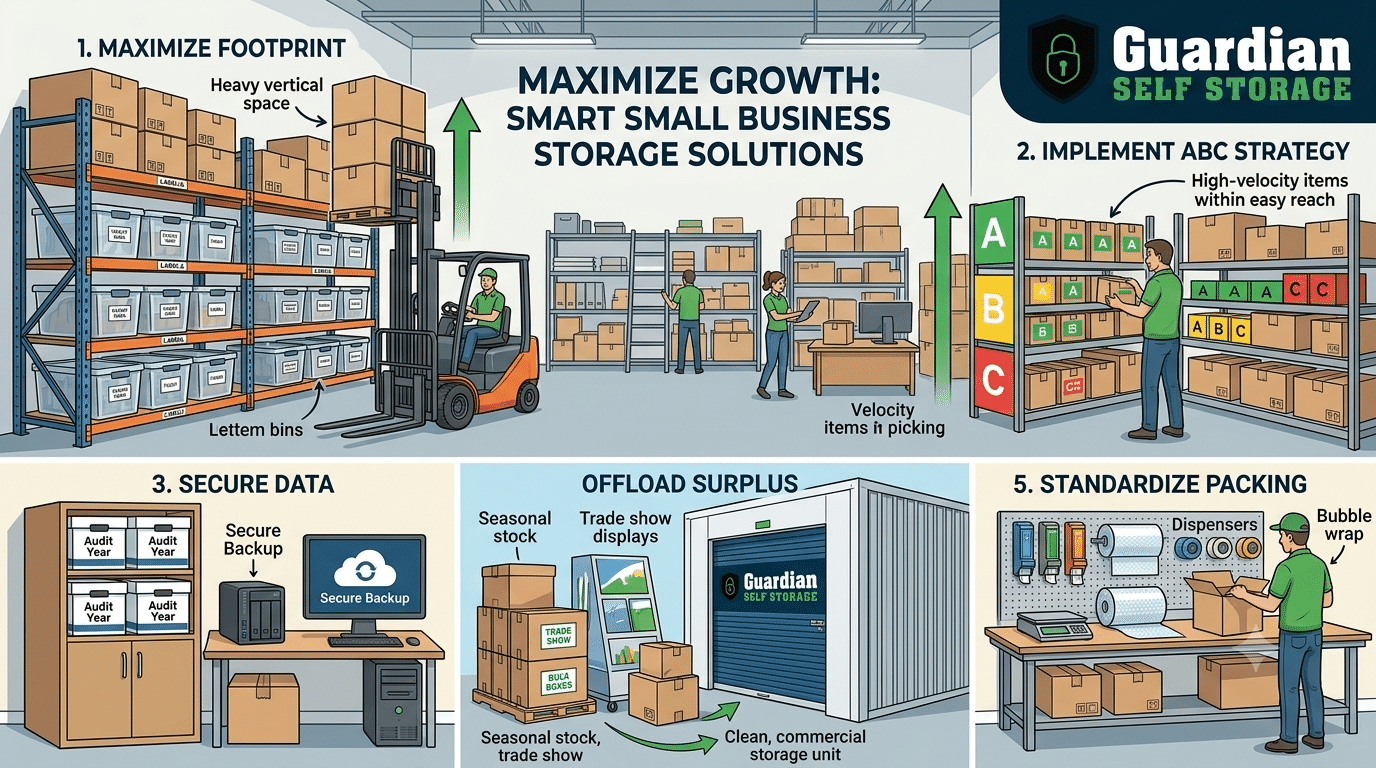
1. Maximize Your Footprint with Vertical Stacking
When floor space runs out, the only way left to go is up. Most small businesses make the mistake of storing inventory on flat surfaces or low shelving units, leaving meters of vertical air space completely unused.
- Install Heavy Duty Steel Shelving: Free standing, industrial grade steel racks let you stack heavy inventory safely without risking collapsed boxes.
- Use Clear, Uniform Bins: Swap mismatched cardboard boxes for transparent plastic containers. Clear bins allow your team to immediately spot items without opening every lid.
- Label Every Corner: Implement a clear barcode or color coding system on every rack and bin. Labeling both the shelf edge and the container ensures items always return to their designated spots.
By taking full advantage of vertical height, you can double or even triple your stock capacity without increasing your rental footprint.
2. Implement the ABC Inventory Strategy
Not all inventory moves at the same velocity. Treating all products equally in your layout leads to wasted footsteps and delayed shipping times. The ABC method categorizes stock based on demand and turnover rate:
| Category | Description | Placement Strategy |
| Category A (Fast Movers) | The top 20% of your catalog that accounts for roughly 80% of sales. | Place at chest to waist height near packing tables for effortless access. |
| Category B (Medium Movers) | Items with steady but moderate demand. | Store on middle to lower shelves slightly further from packing zones. |
| Category C (Slow Movers & Seasonal) | High value, custom, or seasonal stock with lower turnover. | Move to top shelves or off site units to preserve prime packing space. |
Organizing your physical layout according to sales frequency eliminates unnecessary movement and accelerates daily pick and pack operations.
3. Protect Critical Data with Document and Network Storage
Physical stock is only half the battle. As your enterprise scales, physical paperwork tax records, client contracts, and compliance paperwork can quickly overwhelm office filing cabinets. At the same time, digital files demand secure, centralized accessibility.
To keep both physical paperwork and digital records under control, adopt a dual storage approach:
Physical Document Management
Keep hard copies organized in standardized, heavy duty banker boxes clearly labeled with destruction dates or audit years. Utilizing dedicated document storage solutions for business keeps sensitive records compliant, fire-safe, and out of your everyday operational workspace.
Digital File Archiving
To prevent local hard drives from overflowing with high resolution product photos and financial files, deploy small business network storage solutions like Network Attached Storage (NAS) paired with encrypted cloud backups. This gives your team seamless, local network access to vital operational data while guarding against hardware crashes.
4. Offload Excess Stock to Dedicated Commercial Units
As product lines expand, keeping all inventory inside a retail store, spare room, or office becomes impractical and expensive. Commercial leases for prime retail or office space carry high per square meter costs. Using premium office space simply to store bulk cardboard boxes strains cash flow unnecessarily.
Transitioning surplus inventory, seasonal stock, trade show displays, and archive boxes to an off site facility provides a cost effective alternative. External business storage solutions allow you to maintain an agile core workspace while scaling unit sizes up or down as seasonal demand fluctuates.
Partnering with a reliable storage solutions business gives you flexible access, heightened security, and climate-controlled protection for your inventory. Facilities like Guardian Self Storage offer secure commercial storage units tailored specifically for local small businesses needing accessible, scalable space without locked-in, long-term commercial lease commitments.
5. Standardize Your Packing and Dispatch Zone
Even the most organized inventory layout fails if your packing station is disorganized. Create an assembly line setup to keep dispatch fast and error free:
- Keep Shipping Supplies Accessible: Hang tape dispensers, bubble wrap rolls, and shipping labels directly above the packing workbench at eye level.
- Standardize Box Sizes: Limit your shipping boxes to 3 to 4 standard dimensions to simplify stacking and reduce dimensional weight shipping costs.
- Incorporate Weighing Stations: Integrate an accurate shipping scale directly into your workbench workflow to avoid overpaying at dispatch.
High-density shelving keeps commercial inventory accessible, but your stock relies heavily on the facility’s security infrastructure. Verifying that a site meets key storage security standards prevents break-ins and property loss. If your company also uses mobile work trailers or utility vehicles, implementing clear vehicle storage prep routines maintains your fleet during off-peak months.
Conclusions:
An organized warehouse or storage room directly translates to a healthier bottom line. By implementing vertical storage, applying ABC inventory management, securing both physical records and digital files, and utilizing flexible off-site units, you remove physical bottlenecks holding your company back.
Take a fresh look at your current workspace today: identify where stock is cluttering your flow, and start applying these practical inventory hacks to build an efficient, scalable foundation for your business.