Choosing storage involves more than comparing prices and unit sizes. You also need to understand who can enter, how the facility monitors activity and what happens when something goes wrong.
If you’re researching how to choose a safe and secure storage facility, arrange a visit before booking. Visible cameras and fencing matter, but their condition and operation matter just as much.
Use this secure storage facility checklist to ask practical questions and compare your options. No facility can eliminate every risk, but clear answers help you make an informed decision.
1. Check the Access Control System
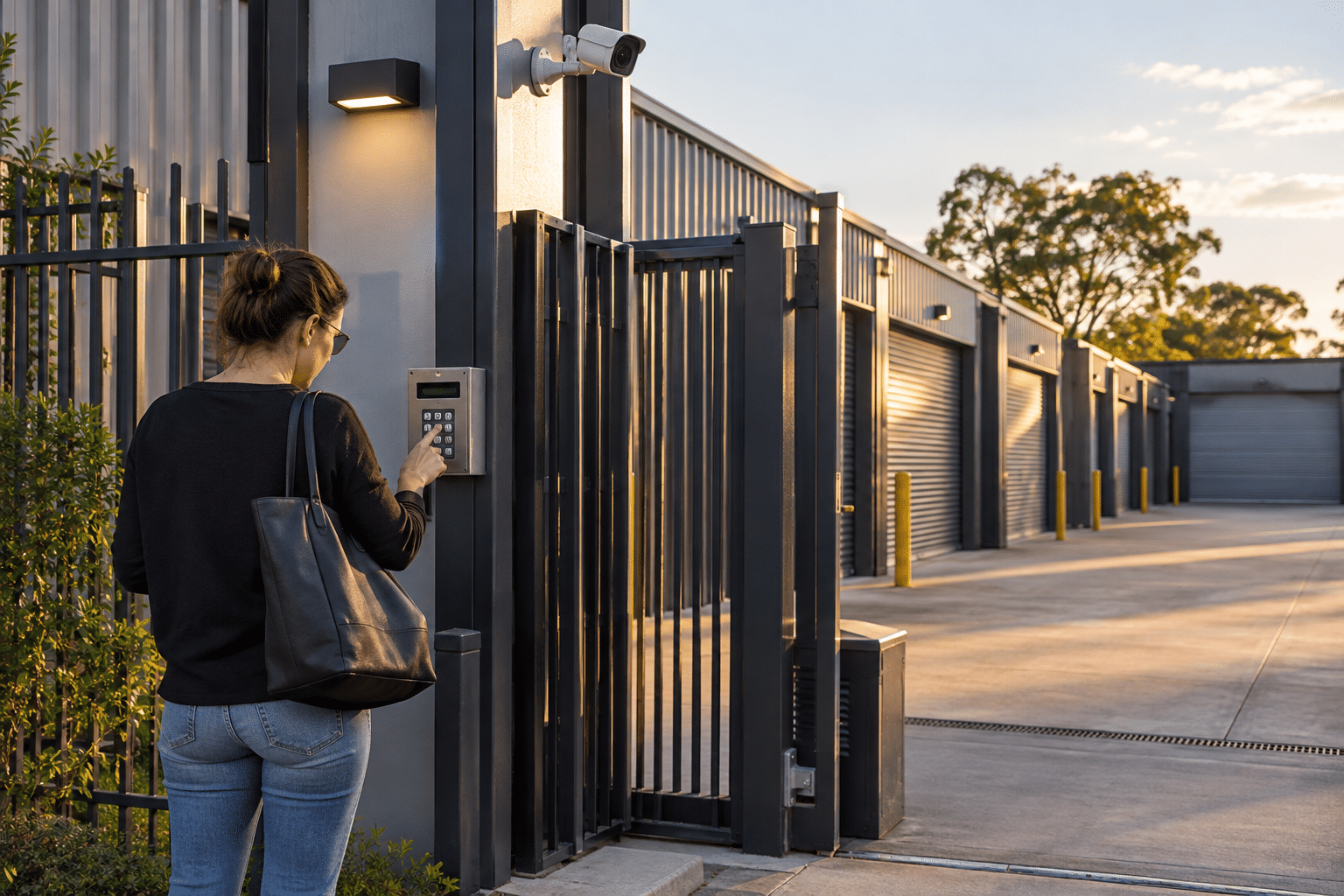
Ask how customers enter and leave the facility. An access control system should help staff manage authorised entry.
A keypad or PIN system offers better accountability when each customer receives a unique code. Shared codes make individual access harder to trace.
Ask these questions:
- Does each customer have a separate PIN?
- Can staff cancel a lost or compromised code?
- Does the gate close automatically?
- How does the facility manage visitors?
When comparing personal storage options, consider how you will access your belongings safely. Keep your code private and report gate faults promptly.
2. Ask About CCTV Coverage and Recording
Look for CCTV around entrances, exits, loading areas and access routes. Ask staff which areas the cameras cover.
Camera numbers alone tell you little. Positioning, image quality, lighting and maintenance affect how useful recordings become.
Confirm whether cameras record continuously, respond to movement or use another arrangement. Recording footage does not necessarily mean someone watches it live.
Ask who reviews suspicious activity and how staff handle recording faults.
For a broader explanation of layered protection, read what makes a storage facility truly secure. Cameras work best alongside controlled access, suitable locks and a clear response process.
3. Confirm How Unit Alarms Work
Individual unit alarms can add protection beyond the main gate. Ask whether your chosen unit has one and how it operates.
Find out whether entering your PIN disarms only your unit or affects a wider area. Confirm how the alarm resets when you leave.
Ask what happens after an unexpected activation. A sounding alarm and remote alarm monitoring provide different response arrangements.
Standards Australia publishes alarm standards in the AS 2201 series and CCTV guidance associated with AS 4806. If a facility claims compliance, ask which current parts and editions apply.
A standards reference alone does not prove that every security feature works properly.
4. Inspect Perimeter Fencing and Gates
Walk around the accessible areas during your visit. Look for damaged perimeter fencing, loose panels and gates that fail to close.
Check whether the boundary creates an obvious route for unauthorised entry. Nearby objects or overgrown vegetation may make access easier or hide activity.
Watch how the entrance gate operates. Ask staff how they address vehicles following another customer through without using a code.
You should not need to test the system yourself. Report anything that concerns you.
A well-maintained boundary helps control access. However, fencing should support other safeguards rather than serve as the facility’s only protection.
5. Assess Lighting and Visibility
Good lighting helps you move safely and makes unusual activity easier to notice.
Check entrances, corridors, loading spaces and the route to your unit. Ask whether lights operate automatically and how staff report or replace failed fittings.
If evening access matters, ask about conditions after dark. A daytime visit may not reveal poorly lit areas.
Keep visibility in mind when choosing larger storage units, particularly if you will move bulky furniture or equipment.
You need enough room to load safely without blocking access routes. Avoid relying on your vehicle headlights as the main lighting source.
6. Check Staff Availability and Emergency Response
Ask whether the facility has an on-site manager and when staff attend. Office hours may differ from customer access hours.
An on-site presence can help with faults, suspicious activity and customer questions. However, staff may not remain there overnight.
Confirm who answers urgent calls outside office hours. Ask how the facility handles a failed gate, alarm activation or suspected break-in.
If the facility offers 24/7 access, check what support remains available during those hours. Round-the-clock entry does not mean round-the-clock staffing.
Clear response arrangements matter more than vague assurances that someone will deal with a problem.
7. Examine Unit Doors, Locks and Overlocking Rules
Inspect the unit door, hinges and locking point. Look for damage, poor alignment or a latch that does not close securely.
Ask which locks fit the door. A suitable disc lock reduces exposed shackle space, but correct fit and quality still matter.
Check whether you supply the lock and retain the keys. Ask how staff manage emergency access.
Overlocking means the operator adds a lock or restriction under specified circumstances. It does not replace your own security.
Read the agreement to understand when overlocking applies, how staff notify you and what happens before access resumes. Never assume every facility follows the same process.
8. Review Fire Safety and General Maintenance
Security includes protection from hazards as well as theft.
Look for clear access routes, tidy common areas and maintained safety equipment. Ask how the facility manages fire safety inspections and emergency procedures.
Confirm the rules for fuels, batteries, chemicals and other restricted materials. Do not assume an item is acceptable simply because it fits inside the unit.
Inspect for leaks, pest activity and damaged electrical fittings. Report concerns before moving in.
This guide to safe and secure self-storage features can help you assess the wider environment. Good maintenance supports both safety and everyday usability.
9. Ask About Access Logs and Privacy
Ask whether the system keeps access logs or an audit trail. These records can help staff investigate unusual entry patterns, although they do not prove who physically used a code.
CCTV footage may contain personal information. Where the Privacy Act 1988 covers the operator, the Australian Privacy Principles govern its handling. State and territory surveillance laws may also apply.
Ask who can access recordings, how long staff retain them and how they protect them.
Do not assume you can view footage containing other customers. Ask how the facility handles an incident and preserves relevant records for investigation.
Compare Your Options Before Booking
Ask Guardian Self Storage about the features available at your preferred location. Confirm access hours, alarms, staffing and contract terms for the specific facility.
If you need clarification before choosing, contact the Guardian team with your questions.
Conclusion
Choose storage by checking how its security measures work together.
Inspect the site, ask practical questions and read the agreement. Clear information helps you select a facility that suits your belongings and access needs.